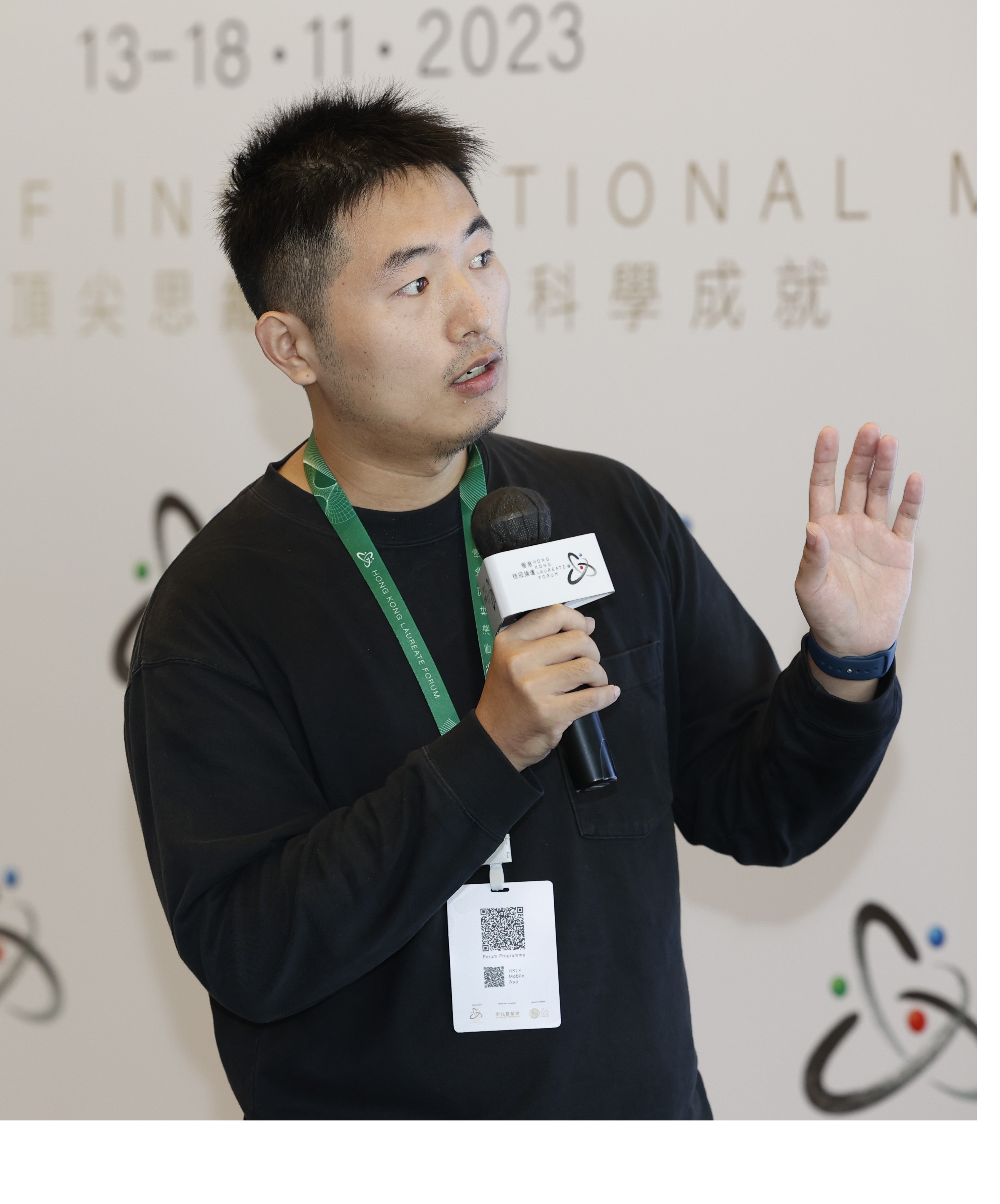
I am a Young Scientist Training Fellow at Asia Pacific Center for Theoretical Physics.
I mainly work on gravitational wave cosmology and astrophysics, and use gravitational wave as a probe to understand the fundamental physics in cosmology, such as cosmic tensions in Lambda-CDM model, the property of dark universe, and the origin of primordial black holes. Based on my work, I try to understand the origin of the universe.
Contact information:
Room 523, Asia Pacific Center for Theoretical Physics,
Hogil Kim Memorial Building #501 POSTECH,
77 Cheongam-ro, Nam-gu, Pohang-si, Korea.
Email: qianhang.ding@apctp.org
Education
2018-2023 PhD in Physics, Department of Physics, The Hong Kong University of Science and Technology
2014-2018 Bachelor of Science, Department of Physics, Shanxi University
Employment
2026-present Young Scientist Training Fellow, Asia Pacific Center for Theoretical Physics
2023-2026 Senior Researcher, Center for Theoretical Physics of the Universe (CGA Group), Institute for Basic Science
2024, 05-06 QUPIP Researcher, QUP, High Energy Accelerator Research Organization (KEK)
2022-2023 Research Assistant, Department of Physics, The Hong Kong University of Science and Technology
Research Interest
Theory: gravitational wave cosmology, cosmic tensions, dark matter, primordial black hole, and fundamental topics
Observation: multi-messenger astronomy such as CMB physics, gravitational wave and pulsar astronomy
Recent Researches
Reconstructing the Dark Matter Equation of State with Compact Object Inspirals [PDF]
Boris Betancourt Kamenetskaia, Qianhang Ding, Hui-Yu Zhu
Abstract:
We investigate the gravitational wave (GW) signatures of compact binaries embedded in extended dark matter (DM) configurations in hydrostatic equilibrium. If a neutron star is surrounded by a sufficiently massive and extended envelope, an inspiraling companion experiences dynamical friction (DF) in addition to the standard GW energy loss. We show that this environmental effect can be isolated through a GW observable, the D-function, which directly characterizes the additional dissipative power induced by the surrounding medium. Since the density of the envelope is directly determined by the DM equation of state together with the stellar boundary conditions, the frequency dependence of the D-function provides direct information about the macroscopic properties of the dark sector. We develop a regression-based framework to reconstruct both the density profile and the DM equation of state over the density range probed by observations of the GW inspiral. Using representative DM models as benchmarks, we demonstrate that the method accurately recovers the input equation of state while remaining largely independent of the microscopic realization of DM. Our results show that future GW observations of compact binaries can provide a probe of the equation of state of DM.
Reconstruction of Primordial Power Spectrum from Gravitational Waves of High-Redshift Black Hole Binaries [PDF]
Qianhang Ding, Xinpeng Wang, Masahide Yamaguchi, Ying-li Zhang
Abstract:
High-redshift binary black hole (BBH) events are promising candidates for primordial black holes (PBHs) detectable by next-generation gravitational wave (GW) detectors. A redshifted mass distribution of detected PBH candidates can be obtained from GW observations, from which the underlying PBH mass function can be reconstructed. In this work, we develop a framework that applies the gradient-descent method to the observed redshifted mass distribution and reconstructs the PBH mass function and, subsequently, the primordial power spectrum (PPS) on small scales. As an illustrative application, we analyze BBH events in the LIGO-Virgo-KAGRA (LVK) catalogs under a specified PBH selection criterion. We find a regularization-stable candidate bump-like enhancement of order 𝒪(10-2) in the reconstructed PPS, centered around kpeak≃5.7×10⁵ Mpc-1 under the adopted assumptions. Our results demonstrate the feasibility of reconstructing the small-scale PPS from high-redshift BBH observations with next-generation GW detectors.
My Research Details in Google Scholar
My CV [Updated at 2 October, 2026]
Outreach
Astrophotography [bilibili Channel]
Popular science article for the Hong Kong Laureate Forum [Link]
Recent News
I leave IBS and join APCTP as YST Fellow on October 1st, 2026.
Our work [2304.08824] with Dr. Ali Akil is awarded The 2025 Blaumann Prize [Link].